
← All marine life
Amphipod
Group

Amphipod

Amphipoda, Latreille, 1816

marinebrackishfreshwater

About Amphipod

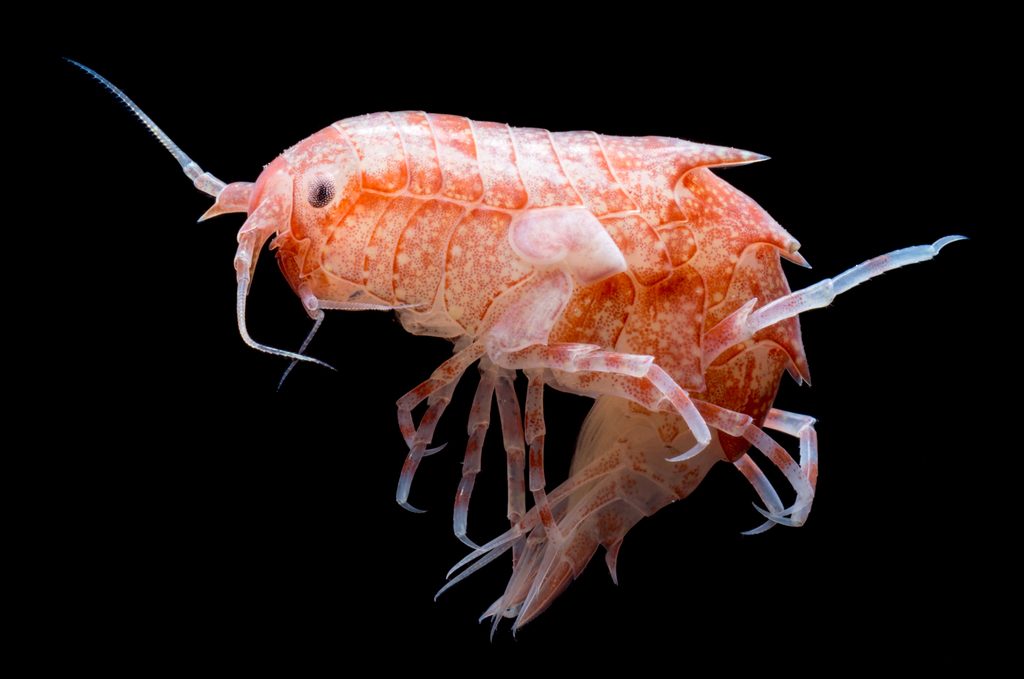
Amphipoda is an order of malacostracan crustaceans characterized by sessile eyes and the absence of a carapace. Amphipods comprise more than 10,700 species, are found in almost all aquatic environments, from fresh water to the deepest parts of the ocean, as well as in terrestrial environments, and generally have laterally compressed bodies.

Most amphipods are marine, although around 20% of species inhabit fresh water and other non-marine environments, while the family Talitridae includes terrestrial landhoppers as well as semi-terrestrial and marine species. Amphipods range in size from less than 1 millimetre (0.04 in) to about 35 centimetres (13.8 in), are mostly detritivores or scavengers, and are an important component of aquatic ecosystems.

Appearance

Amphipods are characterized by sessile eyes (without eyestalks), no carapace, and the presence of gills on the coxae. Their bodies are divided into 13 segments, which can be grouped into the head, thorax and abdomen.

The head is fused to the thorax, and bears two pairs of antennae and one pair of compound eyes. It also carries the mouthparts, but these are mostly concealed. Amphipods are one of the few groups to possess gnathopods, which are uniquely modified feeding legs.

Behaviour

Amphipods are found in almost all aquatic environments, from fresh water to water with twice the salinity of sea water and even in the Challenger Deep, the deepest known point in the ocean. They are almost always an important component of aquatic ecosystems, often acting as mesograzers; a monograph calls them ″integral members of global marine ecosystems″.

Most species in the suborder Gammaridea are epibenthic, although they are often collected in plankton samples. Members of the Hyperiidea are all planktonic and marine; many are symbionts of gelatinous animals, including salps, medusae, siphonophores, colonial radiolarians and ctenophores, and most hyperiids are associated with gelatinous animals during some part of their life cycle.

Reproduction

Amphipods engage in amplexus, a precopulatory guarding behavior in which males will grasp a female with their gnathopods and carry the female held against their ventral surface. Amplexus can last from two to over fifteen days, depending on water temperature, and ends when the female molts, at which point her eggs are ready for fertilisation.

Mature females bear a marsupium, or brood pouch, which holds her eggs while they are fertilised, and until the young are ready to hatch. As a female ages, she produces more eggs in each brood. Mortality is around 25–50% for the eggs. There are no larval stages; the eggs hatch directly into a juvenile form, and sexual maturity is generally reached after six moults. Some species have been known to eat their own exuviae after moulting.

Where to see it

No dive sites list Amphipod yet. Explore the map to find sites near you.