
← All marine life
Alligator
Group

Alligator

Alligator, Cuvier, 1807

brackishfreshwater

About Alligator

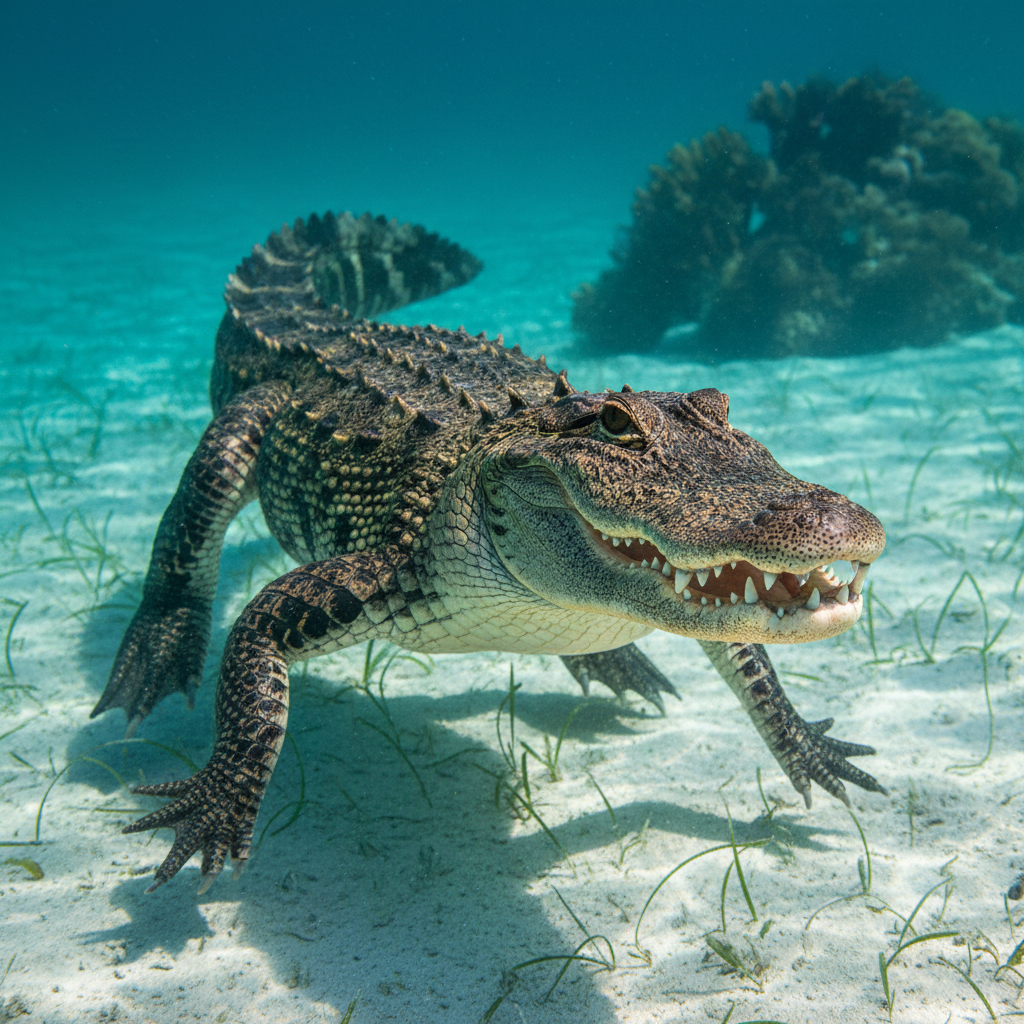
An alligator, or colloquially gator, is a large reptile in the genus Alligator of the family Alligatoridae in the order Crocodilia. The two extant species are the American alligator (A. mississippiensis) and the Chinese alligator (A. sinensis). Additionally, several extinct species of alligator are known from fossil remains. Alligators first appeared during the late Eocene epoch about 37 million years ago.

The term "alligator" is likely an anglicized form of el lagarto, Spanish for "the lizard", which early Spanish explorers and settlers in Florida called the alligator. Early English spellings of the name included allagarta and alagarto.

Alligators are notable for their ability to inhabit climates that are considerably more temperate than those of most other crocodilians. Although they generally prefer subtropical to tropical regions, they are also capable of surviving colder winters in the northern parts of their range.

Appearance

An average adult American alligator's weight and length is 360 kg (790 lb) and 4 m (13 ft), but they sometimes grow to 4.4 m (14 ft) long and weigh over 450 kg (990 lb). The largest ever recorded, found in Louisiana, measured 5.84 m (19.2 ft). The Chinese alligator is smaller, rarely exceeding 2.1 m (7 ft) in length. Additionally, it weighs considerably less, with males rarely over 45 kg (100 lb).

Adult alligators are black or dark olive-brown with white undersides, while juveniles have bright yellow or whitish stripes which sharply contrast against their dark hides, providing them additional camouflage amongst reeds and wetland grasses.

Habitat

Alligators are native only to the United States and China.

American alligators are found in the southeast United States: all of Florida and Louisiana; the southern parts of Georgia, Alabama, and Mississippi; coastal South and North Carolina; East Texas, the southeast corner of Oklahoma, and the southern tip of Arkansas. Louisiana has the largest alligator population. The majority of American alligators inhabit Florida and Louisiana, with over a million alligators in each state. Southern Florida is the only place where both alligators and crocodiles coexist.

Diet

The type of food eaten by alligators depends upon their age and size. When they are young, alligators eat fish, insects, snails, crustaceans, and worms. As they mature, progressively larger prey is taken, including larger fish, such as gar, turtles, and various mammals, particularly nutrias and muskrats, as well as birds, deer, and other reptiles. Their stomachs also often contain gizzard stones. They will consume carrion if they are sufficiently hungry. In some cases, larger alligators are known to ambush dogs, Florida panthers, and black bears, making them the apex predator throughout their distribution. In this role as a top predator, it may determine the abundance of prey species, including turtles and nutrias.

Behaviour

Large male alligators are solitary territorial animals. Smaller alligators can often be found in large numbers close to each other. The largest of the species (both males and females) defend prime territory; smaller alligators have a higher tolerance for other alligators within a similar size class.

Alligators move on land by two forms of locomotion, referred to as "sprawl" and "high walk". The sprawl is a forward movement with the belly making contact with the ground and is used to transition to "high walk" or to slither over wet substrate into water. The high walk is an up-on-four-limbs forward motion used for overland travel with the belly well up from the ground. Alligators have also been observed to rise up and balance on their hind legs and semi-step forward as part of a forward or upward lunge. However, they can not walk on their hind legs.

Reproduction

Alligators generally mature at a length of 1.8 m (6 ft). The mating season is in late spring. In April and May, alligators form so-called "bellowing choruses". Large groups of animals bellow together for a few minutes a few times a day, usually one to three hours after sunrise. The bellows of male American alligators are accompanied by powerful blasts of infrasound. Another form of male display is a loud head-slap. In 2010, on spring nights alligators were found to gather in large numbers for group courtship, the so-called "alligator dances".

Humans & conservation

Alligators are raised commercially for their meat and their skin, which when tanned is used for the manufacture of luggage, handbags, shoes, belts, and other leather items. Alligators also provide economic benefits through the ecotourism industry. Visitors may take swamp tours, in which alligators are a feature. Their most important economic benefit to humans may be the control of nutrias and muskrats.

Alligator meat is also consumed by humans.

Where to see it

No dive sites list Alligator yet. Explore the map to find sites near you.