
← All marine life
Alewife
Species IUCN · Least Concern (LC)

Alewife

Alosa pseudoharengus, (Wilson, 1811)

marinebrackishfreshwater

About Alewife

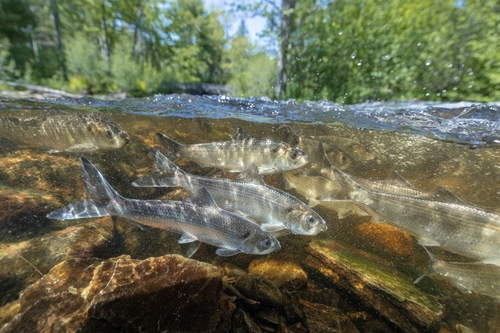
The alewife or river herring (Alosa pseudoharengus; pl.: alewives) is a species of herring found in North America. It is commonly anadromous but there are also significant landlocked populations. It is one of the smaller species of shad, of the subgenus Pomolobus. As an adult it is a marine species found in the northern West Atlantic Ocean, moving into estuaries before swimming upstream to breed in freshwater habitats, but some populations live entirely in fresh water.

It is known for its colonization of the Great Lakes via the Welland Canal, bypassing Niagara Falls. There, its population peaked between the 1950s and 1980s to the detriment of many native species of fish. In an effort to control it biologically, Pacific salmon were introduced, only partially successfully. As a marine fish, the alewife is a US National Marine Fisheries Service "Species of Concern".

Appearance

Alewife reach a maximum standard length (SL) of about 40 centimetres (16 in), but have a typical SL of about 30 centimetres (12 in). The front of the body is deep and larger than other fish found in the same waters.

Alewife have bronze-colored heads and a grey-blue to greyish green dorsum. A humeral spot is often present. The tongue does not bear teeth. The peritoneum is light-colored with spots to dusky-appearing, an internal feature that distinguishes alewife from blueback herring (Alosa aestivalis), which have a dark peritoneum. The otolith is shaped like a letter "L", unlike its hooked shape in A. aestivalis. Additionally, the eye is larger than that of A. aestivalis; the width of the eye often exceeds the length of the snout in A. pseudoharengus.

Humans & conservation

Alewife populations have seen big declines throughout much of their range. Several threats have most likely contributed to their decline, including loss of habitat due to decreased access to spawning areas from the construction of dams and other impediments to migration, habitat degradation, fishing, and increased predation due to recovering striped bass populations.

In response to the declining population trend for alewives, the states of Massachusetts, Rhode Island, Connecticut, Virginia, and North Carolina have instituted moratoria on taking and possession.

Where to see it

No dive sites list Alewife yet. Explore the map to find sites near you.